
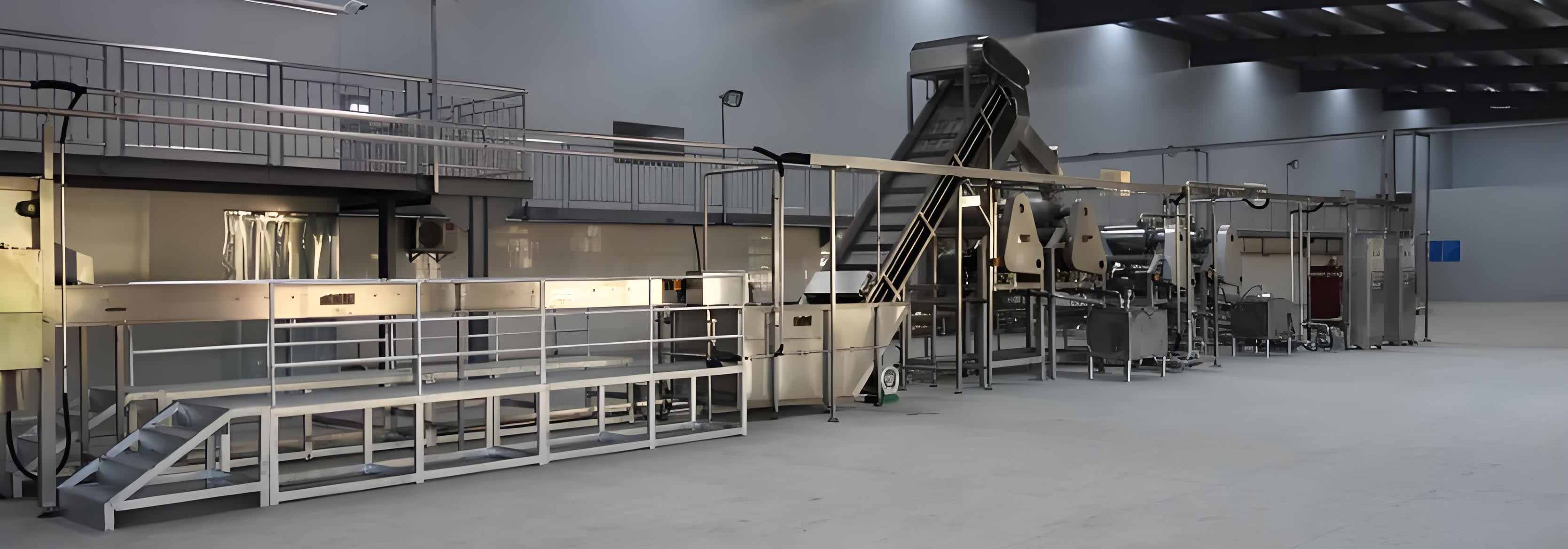
1. Raw Fruit Pressing and Treatment System
2. Juice Mixing and Hot Water System
4. CIP (Clean-in-Place) System
5. System Integration and Control
Design and Process Overview of a 0.5 Ton per Hour Fruit Juice Pre-Treatment Line
The production of high-quality fruit juice requires a well-designed pre-treatment process to ensure product stability, safety, and sensory attributes. A 0.5-ton-per-hour (0.5 T/H) juice pre-treatment line is ideal for small-to-medium-scale production facilities, pilot plants, or craft juice manufacturers. This system integrates four main subsystems: raw fruit pressing and treatment, juice mixing and hot water supply, UHT sterilization, and CIP cleaning. Below is a detailed description of each component and its role in the 0.5 T/H juice pre-treatment process.
Raw Fruit Pressing and Treatment System
This subsystem converts fresh fruit into clarified or pulpy juice. Key equipment includes:
|
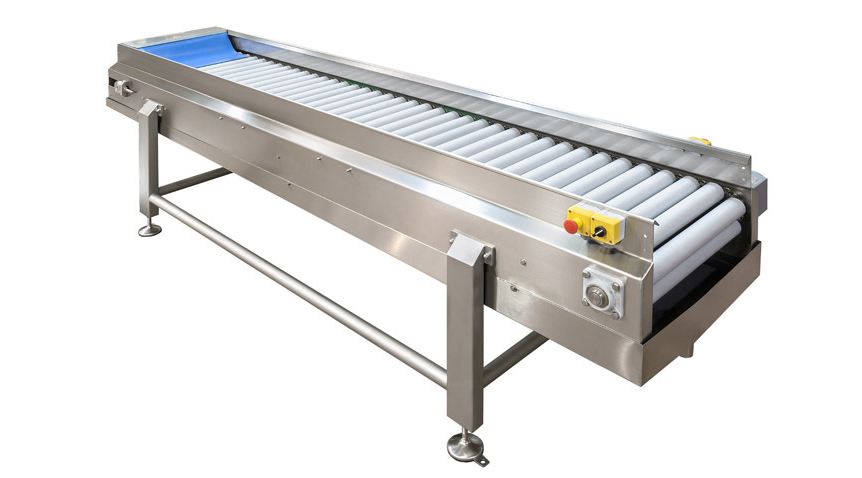
Fruit Sorter (Roller Sorting Conveyor )
The fruit sorter is the first critical control point in the raw fruit treatment system, ensuring that only sound, mature fruits enter the juice production line. For this 0.5 T/H system, a roller sorting conveyor is employed. Unlike flat belt sorters or manual sorting tables, the roller bar design allows fruits to rotate as they travel, exposing all surfaces to the operator’s view. This is particularly beneficial for fruits with subtle defects (e.g., bruises, insect damage, or early-stage rot) that may be hidden on the underside. The rolling action also helps dislodge loose dirt or debris remaining after washing. |
|
 |
|
|
|
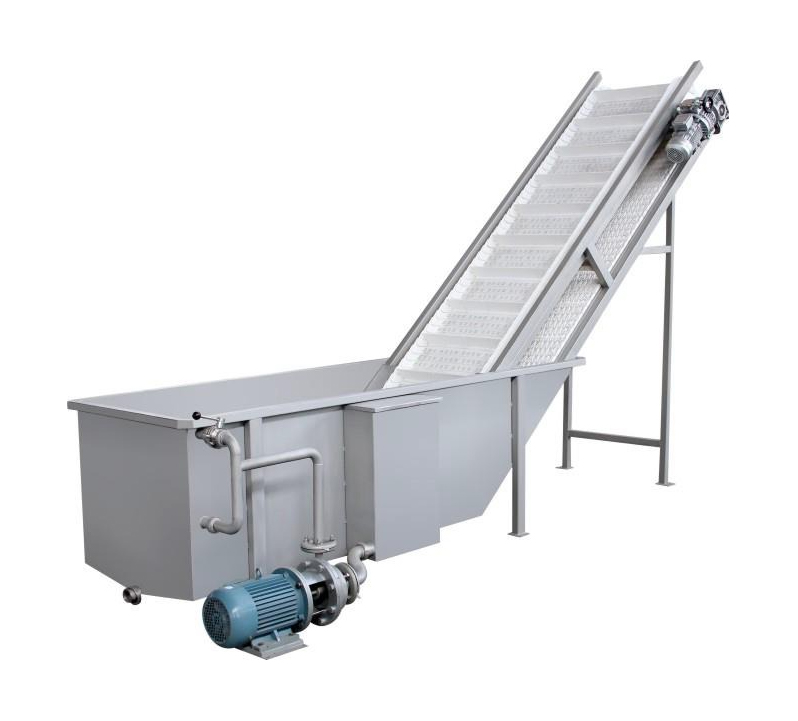
Fruit Washer and Elevator (Bubble Washing with Integrated Inclined Elevator)
This combined unit integrates bubble washing and inclined lifting into a single machine, saving floor space and reducing fruit handling damage.
Working Principle:
Fruits enter the water-filled stainless steel tank where multiple rows of air nozzles release compressed air from a blower. The rising bubbles create vigorous turbulence, causing fruits to tumble and rub against each other, effectively scrubbing away dirt, surface microbes, and pesticide residues without bruising. After washing, a perforated inclined belt (30°–45°) lifts fruits out of the water. As the belt rises, water drains back into the tank through the perforations. A final rinse spray bar removes residual debris, and clean fruits are discharged directly to the crusher. |
|
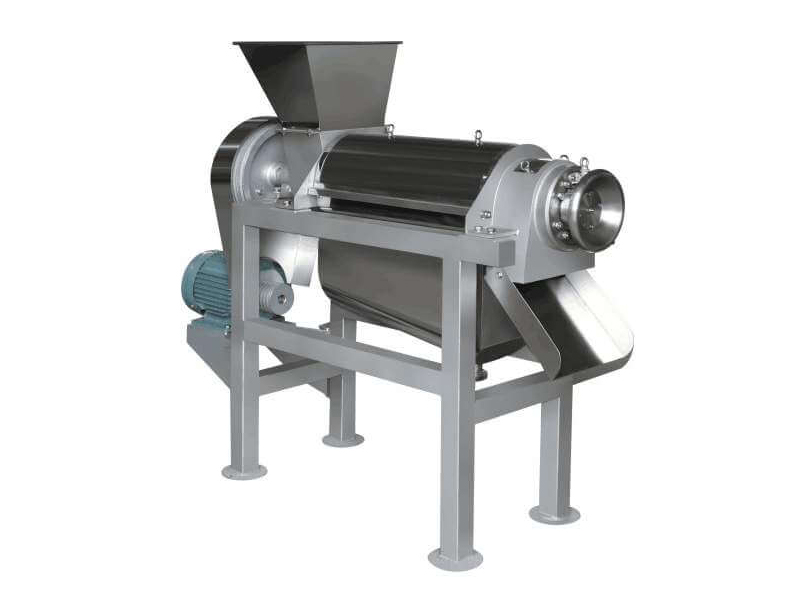
Crushing and Juicing Machine (Pulp-Spiral Juice Extractor)
This combined unit integrates a crusher and a single-screw spiral press for continuous juice extraction. Specifications: processing capacity 0.5 T/h, screw speed 2900 rpm, all food-contact parts (except transmission) in AISI 304 stainless steel.
Working Principle:
Fruits are smashed into coarse pomace by rotating hammers (2900 rpm), then compressed by a tapered spiral screw against a cylindrical screen at 5–15 bar. Juice passes through the screen while dry pomace is expelled. Juice collects in a sanitary pan for downstream processing. |
|
 |
|
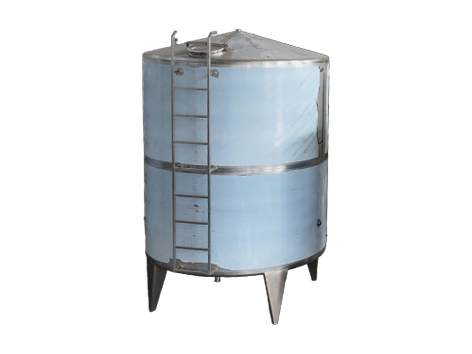
Juice Storage Tank
A 500-litre temporary holding vessel for raw juice, providing buffering between intermittent pressing and continuous downstream flow. Equipped with capacitive level signal output for remote monitoring. |
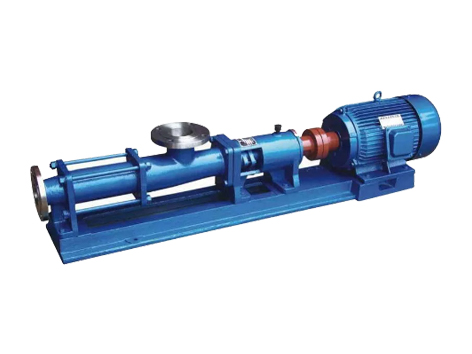
Screw Pump
Gently transfers raw juice without shearing or damaging fruit fibers. Handles high-viscosity, pulpy juices with pulsation-free flow against moderate back pressure from filters. |
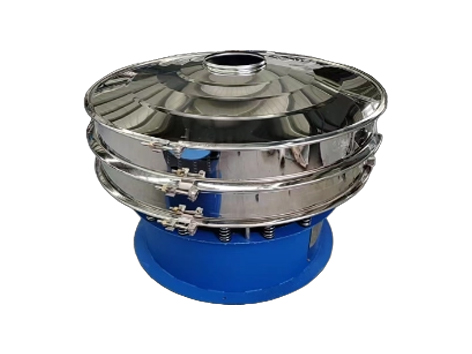
Vibrating Screen
Removes large solids, seeds, and coarse pulp using a 1430 mm effective diameter screen (1470 mm total). Vibrates at 1450 cycles per minute with a 2.2 kW motor. |
||
|
|
|
|
||
 |
 |
 |
Juice Buffer Tank
The juice buffer tank balances flow fluctuations between upstream filtration and downstream pasteurization, ensuring continuous operation of the 0.5 T/H line.
Specifications:
• Material: SUS304 stainless steel
• Dimensions: 1050 × 610 mm
• Construction: Two-layer with PU insulation, conical dished head for complete drainage
• Agitator: Top-mounted offset agitator for gentle mixing to prevent pulp sedimentation
• Inlet: Side feed to minimize splashing
• Level indication: Glass tube level gauge
• CIP cleaning: Centrally positioned spray ball
• Additional features: Nameplate, digital temperature display, sealed manhole, access ladder, and four support legs
Centrifugal Pump & Self-Priming Pump
Centrifugal pump (0.75–1.5 kW, 15–25 m head) transfers juice from buffer tank. Self-priming pump lifts juice from lower-level tanks up to 5–6 meters.
|
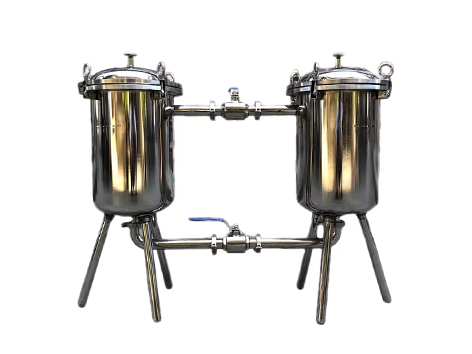
Twin-Filter (Duplex Filter)
Provides fine filtration (20–500 µm depending on product type) with two parallel housings. When pressure differential reaches 1.5–2.0 bar, flow switches to the clean housing. |
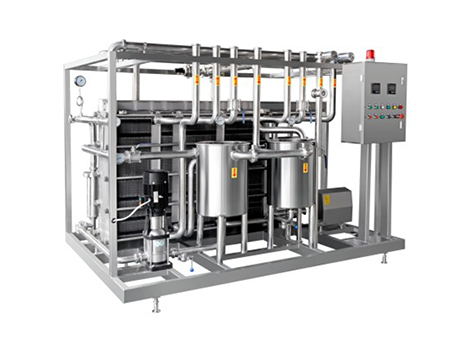
Pasteurizer
The pasteurizer applies controlled thermal treatment to inactivate enzymes and spoilage microorganisms. Process parameters: 4°C → 65°C (pre-heating before homogenization) → 85–95°C for 15 seconds → rapid cooling back to 4°C. |
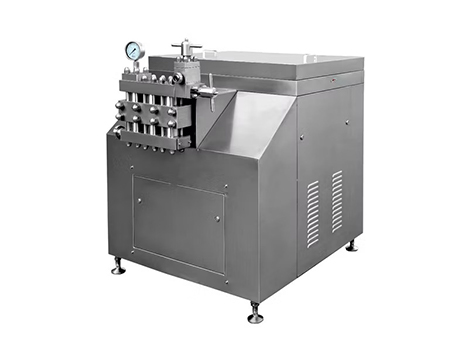
Homogenizer
Reduces particle size to below 10–20 µm at 100–200 bar (or 50–100 bar for citrus to avoid gelation), preventing sedimentation and improving mouthfeel. Flow rate matches 0.5 T/H. |
||
|
|
|
|
||
 |
 |
 |
Juice Mixing and Hot Water System
This section adjusts juice formulation and provides thermal utility:
Hot Water Tank
The hot water tank stores heated water (80–95°C) for pasteurization, UHT heating, and CIP rinsing. Specifications: 1000L capacity, SUS304 construction, dimensions 1700 × 1500 mm, two-layer design with PU insulation, conical dished head, glass tube level gauge, nameplate and digital temperature display, sealed manhole, and four adjustable legs.
|
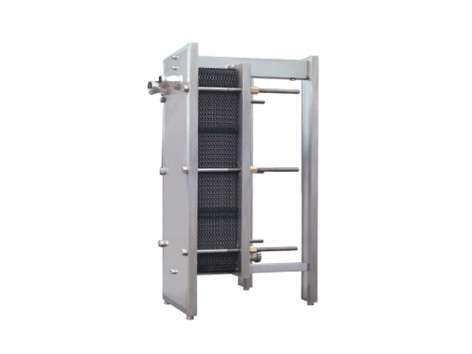
Plate Heat Exchanger (PHE)
Efficiently transfers heat between juice and service media. Specifications: 16 m² heat transfer area, AISI 316L plates with EPDM gaskets. |
Juice Mixer
Continuously blends juice with sugar syrup or acidulants for standardized brix and acidity. 1 T/H capacity, helical elements, no moving parts. |
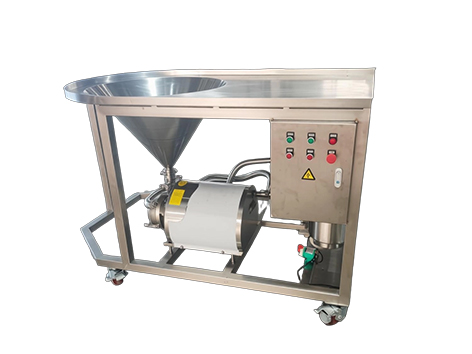
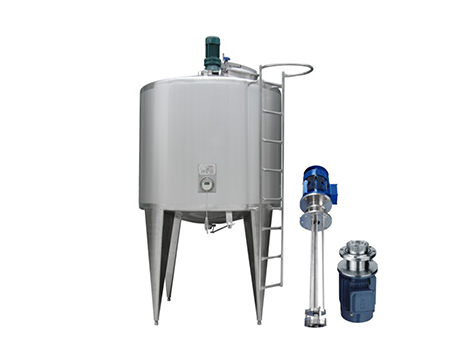
High-Speed Circular Emulsifying Tank
Dissolves stabilizers, pectin, or oil-soluble flavors. Specifications: insulated, 1000L, agitator 2900 r/min, PT100, high/low level detection. |
||
|
|
|
|
||
 |
 |
 |
Agitated Tank (Blending Tank)
The blending tank holds mixed juice with gentle stirring to maintain homogeneity before UHT treatment. Specifications: 1000L capacity, SUS304 construction, two-layer with PU insulation, conical dished head, top-mounted offset agitator, side feed inlet, glass tube level gauge, central CIP spray ball, nameplate and digital temperature display, sealed manhole with access ladder, four adjustable legs, diaphragm level sensor, and capacitive level transmitter.
Twin-Filter (Duplex Filter)
Provides fine filtration (20–500 µm depending on product type) with two parallel housings. When pressure differential reaches 1.5–2.0 bar, flow switches to the clean housing.
Centrifugal Pump & Self-Priming Pump
Centrifugal pump (0.75–1.5 kW, 15–25 m head) transfers juice from buffer tank. Self-priming pump lifts juice from lower-level tanks up to 5–6 meters.
UHT Sterilization System
The UHT system ensures commercial sterility with precise temperature control. Process parameters (1 T/H capacity, 30–40°C feed): heating to 60–65°C for deaeration and homogenization → 80–120°C for sterilization → cooling to 86–95°C for hot filling → final cooling to 30°C for return flow.
High-Pressure Homogenizer
The high-pressure homogenizer reduces particle size and disrupts microbial clumps, enhancing product stability and thermal sensitivity of microorganisms. Installed before the UHT tube, it ensures uniform texture and improves sterilization efficiency. Specifications: 1000 L/H, 1 T/H capacity, 40 MPa (400 bar) maximum pressure, equipped with a variable frequency motor for precise flow control and energy savings.
|
|
|
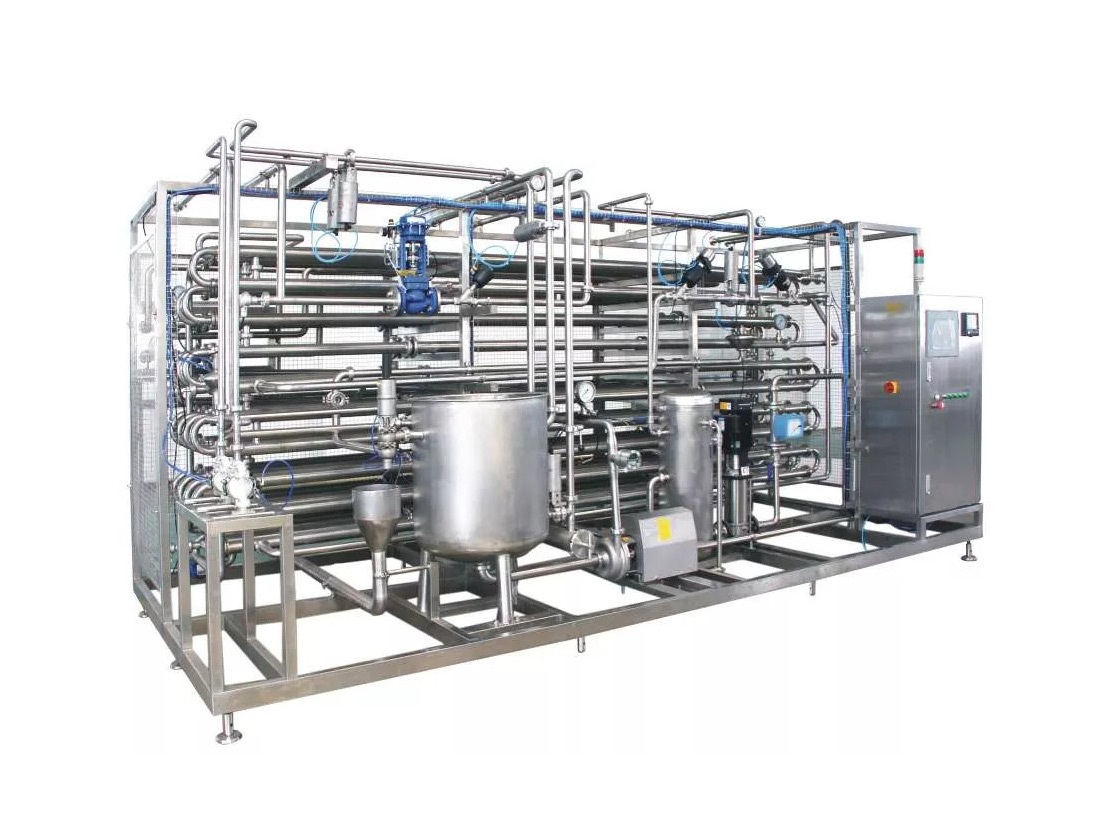
UHT Sterilization Tube The UHT sterilization tube holds juice at high temperature for rapid microbial inactivation without compromising flavor or nutritional quality. Using indirect heating (hot water or steam circulating outside the tube), the juice reaches 80–120°C for a controlled holding time of 4–10 seconds. The multi-layer tube-in-tube design maximizes heat transfer efficiency while minimizing fouling. The inner tube is constructed from AISI 316L stainless steel with an electropolished internal surface (Ra < 0.8 µm) to prevent product adhesion and facilitate CIP cleaning. Any under-temperature juice is automatically diverted back for reprocessing. Specifications: 1 T/H capacity. |
|
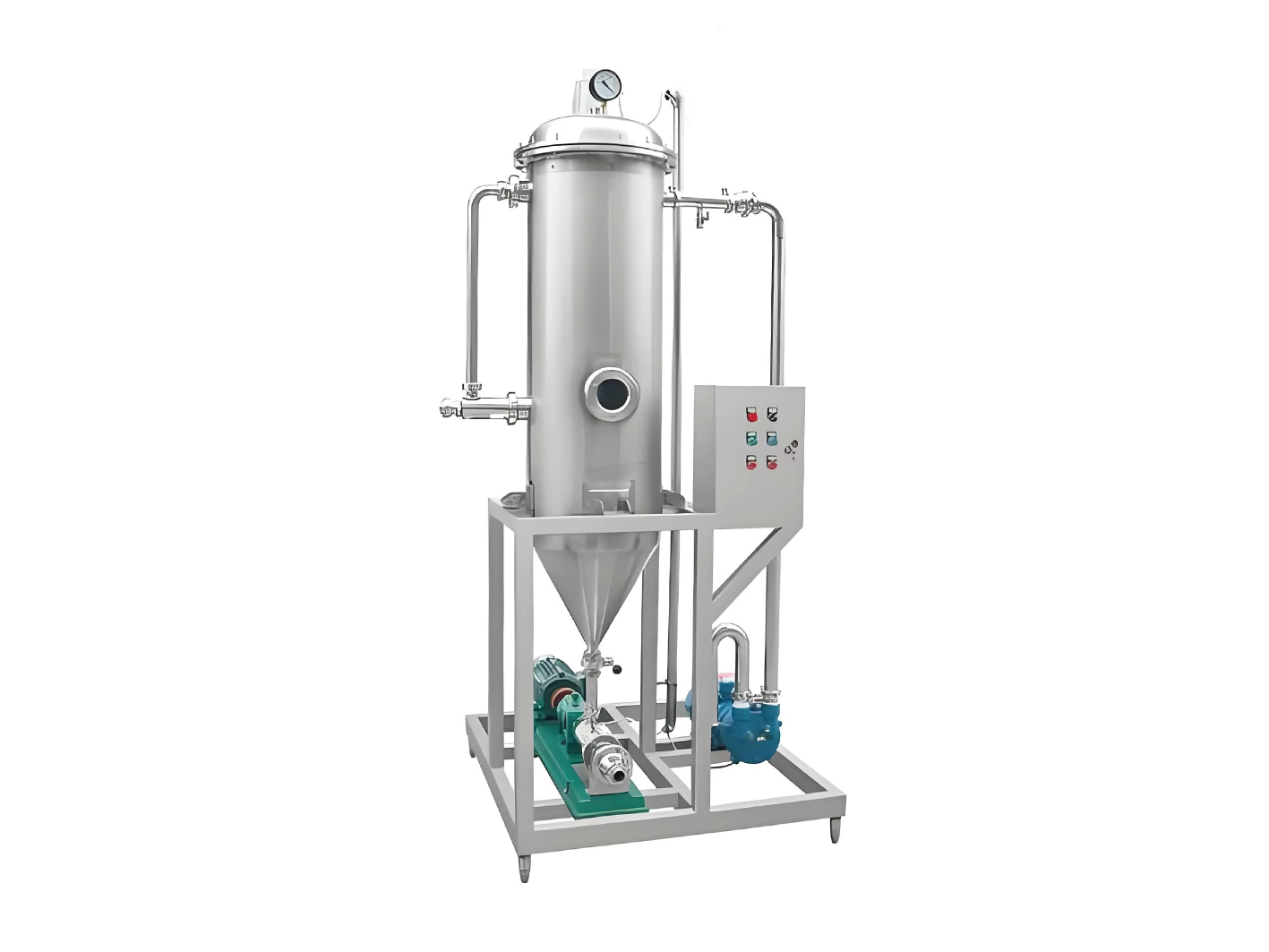
Vacuum Deaerator The vacuum deaerator removes dissolved oxygen and volatile off-flavors from juice before UHT treatment, reducing oxidative browning, vitamin C degradation, and flavor loss during shelf life. Operating under vacuum (absolute pressure 20–50 mbar), juice is sprayed or cascaded over a packed column to maximize surface area, allowing dissolved oxygen to escape rapidly. Oxygen concentration is reduced from 8–10 ppm to below 1 ppm. The 1000L stainless steel vessel features an automatic level refill system to maintain constant liquid level. Volatile off-flavors such as terpenes (citrus), hexanal (apple), or aldehydes are also stripped out, improving final juice taste. Specifications: 1000 L/H capacity, 1000L vessel, automatic level refill, vacuum suction pump. |
|
 |
CIP (Clean-in-Place) System
The CIP system ensures all process surfaces are cleaned thoroughly without manual disassembly, maintaining hygienic conditions and reducing downtime. For this 0.5–1 T/H juice line, a compact integrated CIP unit is specified with fully automated operation.
Tank Specifications
All CIP tanks are constructed from SUS304 stainless steel with 3.0 mm wall thickness for durability and corrosion resistance. The tanks feature polyurethane insulation to maintain cleaning solution temperatures and reduce energy loss. The system is configured as an integrated skid-mounted unit, combining all tanks, pumps, and controls on a single frame for easy installation and mobility.
Heating System
The CIP unit is equipped with a 40 m² tubular heat exchanger for efficient heating of water, alkali, and acid solutions. The tube-in-tube design allows rapid temperature ramp-up and precise control, typically achieving 70–80°C for alkali circulation and 60–70°C for acid circulation.
Pumps
• CIP Supply Pump: One dedicated CIP process pump (centrifugal type, 3–5 bar discharge pressure, 3–5 m³/h flow rate) recirculates cleaning solutions through the juice processing line. The pump is made of stainless steel with sanitary seals.
• Chemical Transfer Pump: A pneumatic diaphragm pump transfers concentrated alkali or acid from storage drums to the respective CIP tanks. The air-operated design is intrinsically safe, leak-free, and handles corrosive chemicals reliably.
Alkali Tank Features
The alkali tank (typically 200–300L) includes:
• Agitator: A top-mounted propeller mixer ensures uniform concentration of NaOH solution, preventing stratification.
• Digital Temperature Display: Provides real-time temperature readout for process control.
• Hydrophobic Air Vent Filter: Prevents airborne contaminants from entering the tank during liquid level changes.
• Sampling Valve: A sanitary sampling valve allows easy collection of cleaning solution for concentration or pH verification.
• Armored Sight Glass: A protective metal sheathed sight glass or tubular level gauge with guard allows visual level verification while resisting impact.
Control System
The CIP system is fully automated with a PLC (Programmable Logic Controller) and HMI (Human-Machine Interface) touch screen. The PLC controls all cycle steps (pre-rinse, alkali circulation, intermediate rinse, acid circulation, final rinse) based on time, temperature, and conductivity feedback. The HMI allows operators to select cleaning recipes, monitor real-time parameters (temperature, flow rate, conductivity, tank levels), view alarms, and log cycle data for validation and traceability.
System Integration and Control
• Piping and Valves: All product-contact surfaces are AISI 304 or 316L stainless steel with Ra ≤ 0.8 µm finish. Sanitary tri-clamp fittings (1.5 or 2 inch) are used throughout. Pneumatic butterfly valves enable automatic flow diversion.
• Instrumentation: Magnetic flowmeters (±0.5% accuracy), Pt100 RTD sensors, pressure transmitters (0–10 bar), and radar or capacitance level sensors are installed at key points.
• Control Panel: A central PLC (e.g., Siemens S7-1200) and HMI touch screen (7–10 inches) display real-time data, allow recipe selection, and provide alarms for temperature, flow, filter clogging, or CIP failure. Data logging ensures traceability.
Conclusion
A 0.5 T/H fruit juice pre-treatment line combines robust mechanical extraction, precise mixing, high-temperature UHT sterilization, and automated CIP cleaning to produce safe, stable, and flavorful juice. This configuration is scalable, energy-efficient, and suitable for a variety of fruits (e.g., apple, orange, pear, tropical blends, stone fruits). With proper maintenance and hygiene practices, the line achieves consistent product quality and extended shelf life (typically 6–12 months ambient storage in aseptic packaging). As consumer demand for high-quality, minimally processed juices grows, a well-engineered 0.5 T/H line offers both operational flexibility and economic viability for small-to-medium producers.