

Multi-Section Type Plate Heat Exchanger
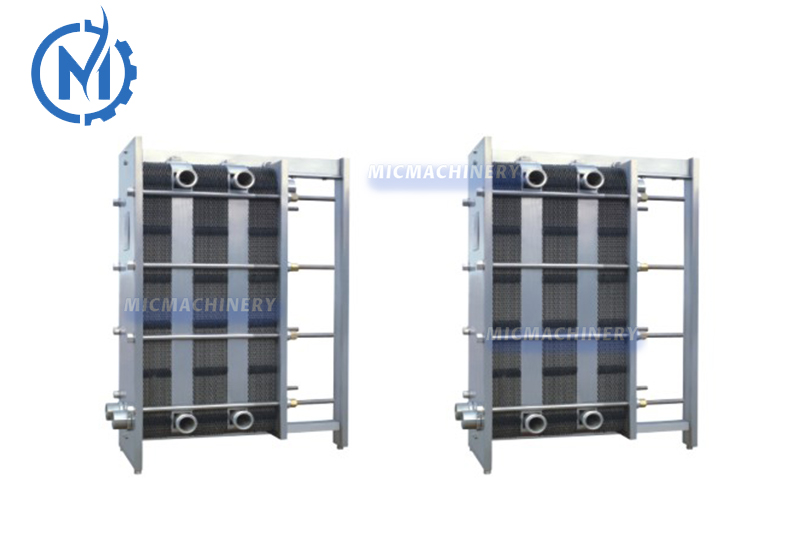
Multi-Section Plate Heat Exchanger | Efficient & Compact
The multi-section type plate heat exchanger is an advanced thermal processing device widely used in the food, beverage, dairy, and chemical industries. It is designed to handle complex heat transfer processes by dividing the unit into multiple independent sections. Each section can perform a specific function such as heating, cooling, regeneration, or holding. This modular design allows for greater flexibility and efficiency compared to single-section units.
Design and Working Principle
The multi-section type plate heat exchanger consists of a series of corrugated metal plates arranged in a frame. These plates are sealed with gaskets and clamped together between a fixed frame plate and a movable pressure plate. The product and the heating or cooling medium flow through alternating channels between the plates, allowing for efficient heat transfer.
As a plate heat exchanger, it offers a compact design with a large heat transfer surface area relative to its footprint. The plates can be arranged in different configurations to create multiple sections, each dedicated to a specific thermal process.
Each heat exchanger plate is pressed with a specific pattern to enhance turbulence and improve heat transfer efficiency. The corrugated design also helps reduce fouling and makes cleaning easier.
Key Features
The plate type heat exchanger is known for its versatility and high performance. Key features include:
• Multi-section design – allows heating, cooling, regeneration, and holding in one unit
• High thermal efficiency – due to turbulent flow created by corrugated plates
• Compact footprint – large heat transfer area in a small space
• Easy maintenance – plates can be opened, inspected, and cleaned individually
• Flexible capacity – plates can be added or removed to adjust capacity
When configured as a heat plate exchanger, the unit can achieve close temperature approaches between media, making it highly energy efficient. The regeneration section can recover a significant portion of heat, greatly reducing operating costs.
Advantages
The multi-section type plate heat exchanger offers several significant advantages:
• High heat transfer efficiency – provides excellent thermal performance
• Low heat loss – minimizes energy waste during operation
• Compact and lightweight construction – saves valuable floor space
• Easy installation and cleaning – reduces maintenance time and costs
• Wide application range – suitable for various industries and products
• Long service life – durable construction ensures years of reliable operation
• Adaptability – as a removable plate type heat exchanger, it offers unmatched adaptability. After installation, the metal plate packs can be increased or decreased to accommodate changing process requirements for expansion or reduction
• Low holdup volume – due to its small flow channels, the holdup volume is very low. This allows for quick start-up, rapid response to control operation changes, and significantly reduces equipment weight
Applications
The multi-section type plate heat exchanger is suitable for a wide range of applications, including:
• Pasteurization for milk, juice, beer, and other beverages
• UHT processing for shelf-stable products such as plant-based milk and cream
• Cooling for sauces, purees, and viscous liquids
• Regeneration to preheat incoming product with outgoing product
• CIP heating for cleaning solutions
As a heat plate exchanger, it is particularly well-suited for low to medium viscosity products without particulate matter. For products containing fibers or large particles, other heat exchanger types may be more appropriate.
Comparison with Tubular Heat Exchangers
Compared to tubular designs, the plate type heat exchanger offers several advantages, including a higher heat transfer coefficient, smaller footprint for the same capacity, lower product holdup volume, easier access for inspection and cleaning, and more flexible capacity adjustment.
However, it has limitations. It cannot handle products with large particles or high fiber content as effectively as tubular designs. Gaskets may also require periodic replacement.
Multi-Section Configuration Example
A typical multi-section plate heat exchanger for milk pasteurization might include the following sections in sequence:
• Regeneration section 1 – preheats the incoming cold product using heat recovered from the outgoing hot product
• Heating section – raises the product to the pasteurization temperature
• Holding tube – maintains the product at the pasteurization temperature for the required time (typically located externally)
• Regeneration section 2 – precools the product while transferring heat back to the incoming product
• Final cooling section – uses cooling medium to bring the product to the desired final temperature
This configuration demonstrates the efficiency of the plate heat exchanger in recovering heat and minimizing energy consumption.
Conclusion
The multi-section type plate heat exchanger is a highly efficient and flexible solution for thermal processing. Its compact design, high thermal efficiency, and ease of maintenance make it a popular choice in the dairy, beverage, and food industries. For producers seeking energy savings and precise temperature control, this equipment remains an outstanding option.
Yoghurt Fermentation Plate Cooler
| Type | Flux (L) | Area (m²) | Material Diameter (mm) | Medium Diameter (mm) | Dimension (mm) | Weight (kg) |
| 0.25-4-1B | 3000 | 4 | 38 | 38 | 600 x 470 x 1400 | 240 |
| 0.25-6-1B | 4000 | 6 | 51 | 51 | 600 x 470 x 1400 | 250 |
| 0.25-8-1B | 5000 | 8 | 51 | 51 | 600 x 470 x 1400 | 260 |
| 0.25-10-1B | 6000 | 10 | 51 | 51 | 600 x 470 x 1400 | 280 |
| 0.25-12-1B | 7000 | 12 | 51 | 63 | 600 x 590 x 1600 | 380 |
| 0.25-15-1B | 8000 | 15 | 51 | 63 | 800 x 590 x 1600 | 400 |
| 0.25-18-1B | 10000 | 18 | 63 | 63 | 800 x 650 x 1600 | 490 |
| 0.25-36-1B | 20000 | 36 | 63 | 63 | 800 x 650 x 1600 | 680 |
Wheat Juice Cooler
| Type |
Malt Extract Capacity (t/h) |
Cooling Consumption (kcal/h) |
Malt Extract Inlet & Outlet Diameter (mm) |
Ice Water Inlet & Outlet Diameter (mm) |
Heat Exchanger Area (m²) |
Outline Dimension (mm) |
Weight (kg) |
| 4-J-70B | 20 | 1740000 | DN100 | DN100 | 70 | 150 x 56 x 160 | 900 |
| 6-J-105B | 30 | 2610000 | DN120 | DN120 | 105 | 140 x 69 x 180 | 1450 |
| 6-J-140B | 40 | 3480000 | DN120 | DN120 | 140 | 150 x 59 x 180 | 1700 |
| 8-J-210B | 60 | 5220000 | DN200 | DN200 | 210 | 240 x 96 x 191 | 2750 |
| 10-J-280B | 80 | 6960000 | DN225 | DN225 | 280 | 240 x 107 x 200 | 3550 |
| 13-J-420B | 120 | 10440000 | DN250 | DN250 | 420 | 260 x 115 x 210 | 4420 |


