

Single-Section Type Plate Heat Exchanger
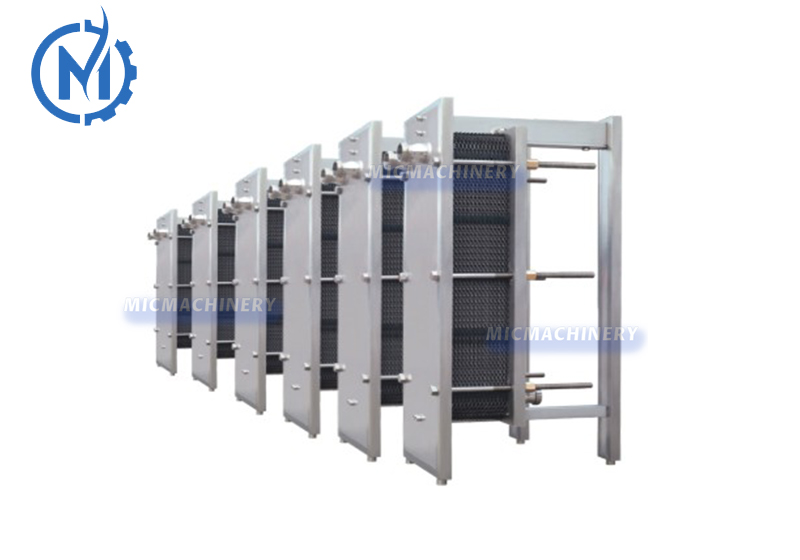
Single-Section Plate Heat Exchanger | Efficient & Compact
The single-section type plate heat exchanger is a fundamental thermal processing device widely used across various industries. Unlike multi-section units that perform multiple functions in one frame, the single-section design focuses on a single thermal task such as heating, cooling, or regeneration. This simplicity makes it an excellent choice for applications where only one heat transfer process is required.
Design and Working Principle
The single-section type plate heat exchanger consists of a series of corrugated metal plates mounted on a frame. These plates are sealed with gaskets and clamped between a fixed frame plate and a movable pressure plate. The product and the heating or cooling medium flow through alternating channels between the plates, allowing efficient heat transfer without mixing.
Each heat exchanger plate features a corrugated pattern that creates turbulence in the flowing media. This turbulence significantly improves heat transfer efficiency compared to smooth surfaces. The plates are typically made of stainless steel, with gaskets selected based on the product and operating temperature.
The plates can be arranged in parallel or series configurations depending on flow rate and pressure drop requirements. The single-section design means all plates participate in the same thermal duty, whether heating, cooling, or regeneration.
Key Features
The plate type heat exchanger is known for its simplicity and reliability. Key features include:
• Single thermal function – performs only heating, cooling, or regeneration
• High heat transfer efficiency – due to turbulent flow from corrugated plates
• Compact design – large heat transfer area in a small footprint
• Easy maintenance – plates can be opened, inspected, and cleaned individually
• Flexible capacity – plates can be added or removed to adjust heat transfer area
• Low holdup volume – small flow channels allow quick start-up and response
The single-section unit offers excellent performance for dedicated thermal tasks. Its straightforward design means fewer gaskets and simpler operation compared to multi-section units.
The Heat Plate Exchanger in Operation
When configured as a heat plate exchanger, the single-section unit operates on the principle of counter-current flow. The hot and cold streams flow in opposite directions through alternating channels, maximizing the temperature driving force across the entire plate surface.
This equipment can achieve very close temperature approaches. For cooling applications, the exiting product temperature can be within 1–2°C of the entering cooling medium temperature. This high efficiency translates directly into energy savings and lower operating costs.
The unit is suitable for a wide range of fluids, including milk, cream, and other dairy products; fruit juices, nectars, and concentrates; beer, wine, and other alcoholic beverages; sauces, syrups, and liquid sugar; plant-based beverages; and CIP cleaning solutions.
However, it has limitations. It is not suitable for products with large particles (typically over 3mm) or high fiber content, as these can clog the narrow channels between plates.
Applications
The single-section unit is suitable for a wide range of applications, including:
• Milk pasteurization – heating milk to required temperatures
• Milk cooling – reducing temperature after pasteurization
• Juice pasteurization – heating fruit juices for shelf-life extension
• Beer wort cooling – reducing temperature before fermentation
• CIP heating – raising cleaning solution temperatures
• Product preheating – warming product before further processing
• Final cooling – bringing product to packaging temperature
In each of these applications, the equipment provides efficient, reliable, and sanitary thermal processing.
Maintenance and Cleaning
The single-section design allows for straightforward maintenance. When cleaning is required, the plate pack can be loosened and opened. Individual plates can be removed for inspection, replacement, or manual cleaning if necessary.
For routine cleaning, the unit supports CIP (Clean-in-Place) procedures. Cleaning solutions are circulated through the unit to remove product residues and sanitize the surfaces. The corrugated plate pattern is designed to promote turbulent flow during CIP, ensuring effective cleaning of all surfaces.
Gaskets are the primary wear component. Depending on operating conditions and cleaning frequency, gaskets typically need replacement every 3–5 years. Proper gasket material selection is critical for compatibility with products, cleaning chemicals, and temperature ranges.
Advantages Over Other Heat Exchanger Types
Compared to tubular or shell-and-tube designs, this equipment offers several advantages:
• Higher heat transfer coefficient – typically 2–4 times higher than tubular units
• Smaller footprint – requires significantly less floor space
• Lower product holdup – reduces product loss during changeovers
• Easier inspection – plates can be opened and examined visually
• Capacity flexibility – plates can be added or removed as needed
• Lower cost – generally less expensive for the same duty
These advantages make this equipment the preferred choice for many liquid processing applications where product viscosity is low to medium and no large particles are present.
Selection Considerations
When selecting a single-section unit, consider the following factors:
• Thermal duty – required heat transfer rate in kW or kcal/h
• Flow rates – product and service media flow rates
• Temperature program – inlet and outlet temperatures for both streams
• Pressure drop – allowable pressure loss through the unit
• Product characteristics – viscosity, particle size, fouling tendency
• Cleaning requirements – CIP compatibility and frequency
• Materials – plate and gasket materials compatible with product and cleaning chemicals
Working with experienced plate heat exchanger suppliers is essential for proper selection and sizing. Reputable suppliers provide technical support, application engineering, and after-sales service. They can help determine the optimal plate pattern, gasket material, and frame size for your specific application.
When evaluating plate heat exchanger suppliers, consider industry experience and references, availability of spare parts and gaskets, technical support and engineering capabilities, lead times and delivery reliability, and warranty and after-sales service. Leading suppliers also offer plate regasketing services, retorquing, and performance audits to ensure your unit continues to operate efficiently throughout its service life.
Conclusion
The single-section type plate heat exchanger is a versatile, efficient, and reliable solution for dedicated thermal processing tasks. With its robust design and high thermal efficiency, this equipment delivers consistent performance for heating and cooling applications across the food, beverage, and dairy industries.
Its compact design, ease of maintenance, and sanitary construction make it an excellent choice for processors seeking a simple yet effective solution. For single-stage heating or cooling of liquid products, this equipment remains a trusted industry standard.
Milk Collection Cooler
| Type | Flux (L) | Area (m²) | Material Diameter (mm) | Medium Diameter (mm) | Dimension (mm) | Weight (kg) |
| 0.1-1-1B | 1000 | 1 | 25 | 25 | 350 x 210 x 600 | 60 |
| 0.1-2-1B | 2000 | 2 | 38 | 38 | 600 x 285 x 810 | 85 |
| 0.25-3-1B | 3000 | 3 | 38 | 38 | 600 x 285 x 810 | 95 |
| 0.25-4-1B | 4000 | 4 | 51 | 51 | 600 x 470 x 1400 | 240 |
| 0.25-5-1B | 5000 | 5 | 51 | 51 | 600 x 470 x 1400 | 250 |
| 0.25-6-1B | 6000 | 6 | 51 | 51 | 600 x 470 x 1400 | 260 |
| 0.25-8-1B | 8000 | 8 | 63 | 63 | 600 x 470 x 1400 | 280 |
| 0.25-10-1B | 10000 | 10 | 63 | 63 | 600 x 590 x 1600 | 380 |
| 0.25-12-1B | 12000 | 12 | 63 | 63 | 800 x 590 x 1600 | 400 |
| 0.25-15-1B | 15000 | 15 | 63 | 63 | 800 x 650 x 1600 | 490 |
| 0.4-20-1B | 20000 | 20 | 76 | 76 | 800 x 650 x 1600 | 540 |
| 0.4-30-1B | 30000 | 30 | 76 | 76 | 800 x 650 x 1600 | 680 |


