

Two-Section Type Plate Heat Exchanger
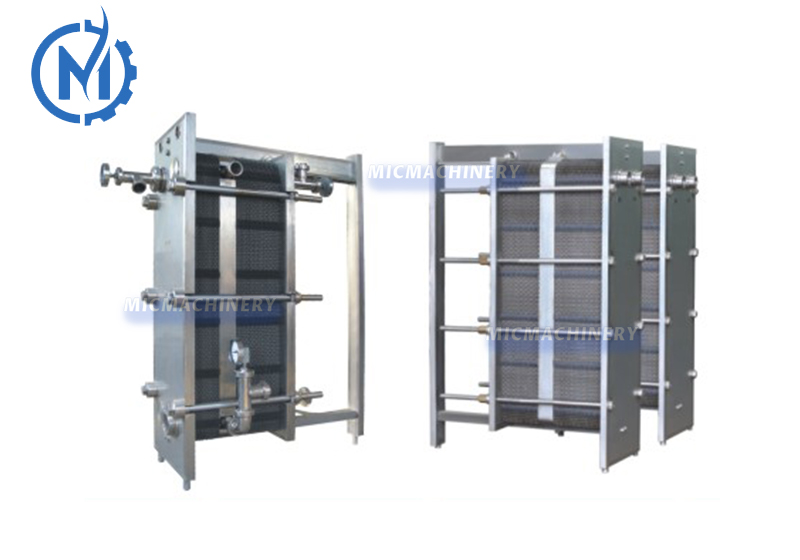
Two-Section Plate Heat Exchanger | Efficient & Compact
The two-section type plate heat exchanger is a thermal processing device designed to perform two distinct heat transfer functions within a single frame. Common configurations include heating plus regeneration, heating plus cooling, or cooling plus regeneration. This dual-section design offers greater efficiency than single-section units while maintaining a compact footprint, making it a popular choice for applications such as milk pasteurization and juice processing.
Design and Working Principle
The unit consists of a series of corrugated metal plates mounted on a frame, divided into two separate sections by intermediate connection plates. Each section can be configured for a different thermal duty. The product flows sequentially through the first section, then the second section, while service media flow through alternating channels in each section.
As a plate heat exchanger, it offers a compact and efficient solution for dual-stage thermal processes. The plates are sealed with gaskets and clamped between a fixed frame plate and a movable pressure plate. The corrugated pattern on each plate creates turbulence, significantly improving heat transfer efficiency compared to smooth surfaces.
Key Features
The plate type heat exchanger is known for its efficiency and versatility. Key features include:
• Dual thermal functions – performs two different tasks in one frame
• High heat transfer efficiency – due to turbulent flow from corrugated plates
• Compact footprint – two sections in a single frame save floor space
• Easy maintenance – plates can be opened, inspected, and cleaned individually
• Flexible capacity – plates can be added or removed in each section
• Energy efficient – regeneration section can recover significant heat
The Heat Plate Exchanger in Operation
When configured as a heat plate exchanger, the two-section unit operates with counter-current flow in each section. The most common application is milk pasteurization, where the first section preheats cold incoming product using heat recovered from hot outgoing product, and the second section raises the product to pasteurization temperature using hot water or steam.
The heat plate exchanger can achieve close temperature approaches, typically within 2–4°C. This high efficiency translates directly into energy savings and lower operating costs. It is suitable for a wide range of fluids, including milk, juice, plant-based beverages, beer, wine, and liquid egg products.
Common Applications
The two-section plate type heat exchanger is suitable for many applications, including:
• Milk pasteurization – regeneration plus heating
• Juice pasteurization – heating plus cooling
• Yogurt milk treatment – preheating plus final heating
• CIP systems – heating plus regeneration for energy recovery
• Beer wort cooling – two-stage cooling with regeneration
• Plant-based beverage processing – various dual-stage configurations
Maintenance and Cleaning
The two-section design allows for straightforward maintenance. When cleaning is required, the plate pack can be loosened and opened. Individual plates can be removed for inspection, replacement, or manual cleaning if necessary.
The unit supports CIP (Clean-in-Place) procedures. Cleaning solutions are circulated through both sections to remove product residues and sanitize all surfaces. The corrugated plate pattern promotes turbulent flow during CIP, ensuring effective cleaning. Gaskets are the primary wear component and typically need replacement every 3–5 years depending on operating conditions and cleaning frequency.
Selection Considerations
When selecting a two-section unit, consider the following factors: thermal duties for both sections, flow rates, temperature program, allowable pressure drop, product characteristics (viscosity, particle size, fouling tendency), cleaning requirements, regeneration ratio, and plate/gasket materials.
Working with experienced plate heat exchanger suppliers is essential for proper selection and sizing. Reputable suppliers provide technical support, application engineering, and after-sales service. They can help determine the optimal plate pattern, gasket material, frame size, and section configuration for your specific application.
When evaluating plate heat exchanger suppliers, consider industry experience, availability of spare parts, technical support capabilities, lead times, and warranty terms. Leading suppliers also offer plate regasketing services and performance audits.
Conclusion
The two-section type plate heat exchanger is a versatile and efficient solution for dual-stage thermal processing. Its compact design, high thermal efficiency, and energy-saving regeneration capability make it a popular choice in the dairy, beverage, and food industries. Working with qualified plate heat exchanger suppliers ensures proper selection, installation, and long-term support for your thermal processing needs.
Ice Cream Freeze Phase 2 Cooler
| Type | Flux (L) | Material Diameter (mm) | Medium Diameter (mm) | Dimension (mm) | Weight (kg) |
| 0.25-8-IIB | 1000 | 25 | 25 | 600 x 285 x 810 | 182 |
| 0.25-12-IIB | 2000 | 38 | 38 | 800 x 470 x 1400 | 259 |
| 0.25-18-IIB | 3000 | 51 | 51 | 1000 x 470 x 1420 | 287 |
| 0.25-22-IIB | 4000 | 51 | 51 | 1000 x 470 x 1420 | 310 |
| 0.25-26-IIB | 5000 | 51 | 51 | 1000 x 470 x 1420 | 339 |
| 0.25-30-IIB | 6000 | 63 | 63 | 1200 x 470 x 1600 | 711 |
| 0.25-36-IIB | 8000 | 63 | 63 | 1500 x 590 x 1600 | 741 |
| 0.25-46-IIB | 10000 | 76 | 73 | 1500 x 590 x 1600 | 787 |


