The term types of oil filling guns for industrial use can describe handheld dispensing guns, metered delivery valves, or the filling nozzles fitted to packaging machines. These products serve different jobs, so buyers need to identify the application before comparing equipment.
This guide explains the main oil filling gun types, the automatic nozzle options used on production lines, and the filling technologies behind them. It also shows how oil properties, containers, and output targets affect equipment selection.
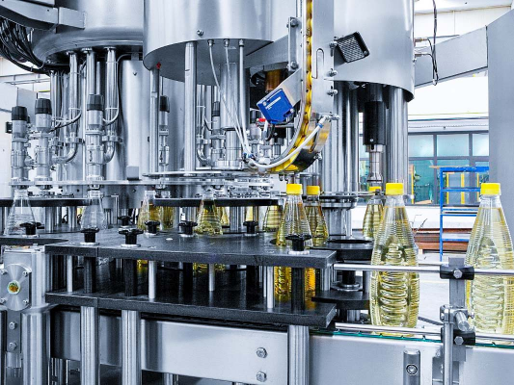
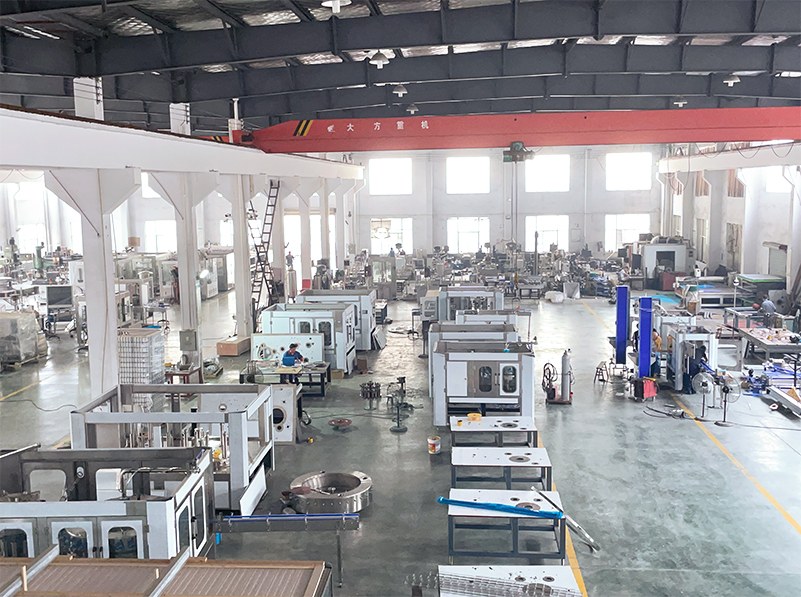
MIC automatic oil filling equipment for bottled oil
What Is an Industrial Oil Filling Gun?
An industrial oil filling gun is the outlet that starts and stops oil flow into a container. A basic gun provides manual on-off control. More advanced models can measure the delivered quantity, stop at a preset amount, or support high-flow transfer into drums and larger containers.
On an automatic packaging line, the equivalent component is usually called a filling nozzle or filling valve. It works with the machine's pump, meter or dosing device, sensors, and control program. The nozzle manages the final delivery point, while the complete dosing system determines the fill quantity.
Oil guns should also be separated from grease guns. A grease gun pushes semi-solid grease through a coupler into a lubrication fitting. An oil gun handles a flowing liquid through a hose or filling circuit.
Five Main Types of Oil Filling Guns for Industrial Use
|
Type
|
How it works
|
Typical application
|
Main checks
|
|
Manual non-metered gun
|
The operator opens and closes the valve
|
Transfer, topping up, and low-volume filling
|
Pump pressure, hose size, outlet type, shutoff
|
|
Mechanical metered gun
|
A mechanical register displays the delivered volume
|
Routine workshop and service dispensing
|
Meter range, calibration, readability, oil compatibility
|
|
Electronic metered gun
|
A digital meter records the quantity
|
Controlled dispensing and usage tracking
|
Meter principle, power, data needs, protection rating
|
|
Preset metered gun
|
The valve closes at a programmed quantity
|
Repeated batches with less operator attention
|
Preset range, repeatability, shutoff response
|
|
High-flow dispensing gun
|
A larger flow path reduces restriction
|
Drums, tanks, IBCs, and bulk transfer
|
Pump capacity, hose loss, handling, splash control
|
Manual non-metered guns suit simple transfer jobs where quantity is checked by another method. Metered guns make the delivered amount visible at the outlet. Mechanical meters keep the arrangement simple, while electronic models can provide batch totals or connect to a fluid-management system. Graco and SAMOA organize dispensing products around these control and metering functions.
Preset guns are useful for repeated known quantities because the valve stops at the target. High-flow guns reduce filling time for larger transfers, provided that the pump, hose, fittings, and receiving container can support the higher delivery rate. A large gun cannot compensate for an undersized pump or excessive pressure loss in the hose.
Automatic Oil Filling Nozzles on Packaging Machines
Automatic nozzles are fixed to the filling machine and controlled by the filling cycle. Their design affects dripping, splashing, air entrainment, and container-neck cleanliness.
Common options include:
- Positive shutoff nozzles, which close near the outlet to control trailing oil and drips.
- Check-valve or ball-check nozzles, which help stop reverse flow after filling.
- Diving or bottom-up nozzles, which enter the container and rise during filling to reduce splashing or surface disturbance in suitable applications.
- Overflow return nozzles, which return excess product and create a consistent visible fill level in rigid containers.
These features can be combined with different dosing systems. Filamatic's filling nozzle overview shows why outlet size, shutoff design, nozzle movement, seals, and cleanability must be matched to the product and container.
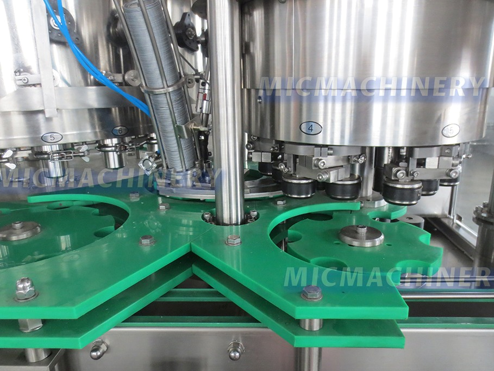
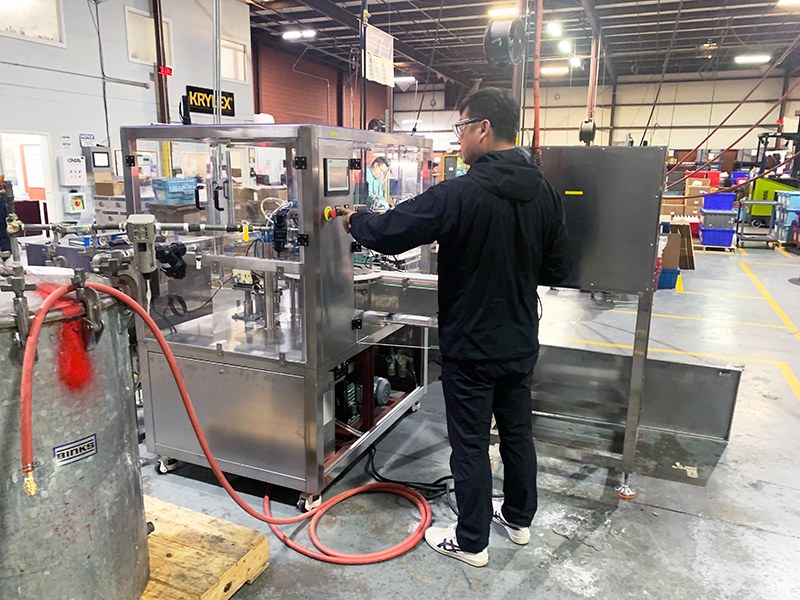
Close-up of a MIC rotary filling station
Filling Technologies Behind the Gun or Nozzle
The gun or nozzle controls the outlet. The filling technology establishes how much oil enters the container.
Gravity Filling
Gravity systems feed oil from a tank above the nozzles. They are most suitable for free-flowing oils and simpler applications. Product level, temperature, and viscosity can change the flow rate, so the process must be tested against the required fill tolerance.
Volumetric Piston or Pump Filling
Volumetric systems dispense a defined volume through a piston, gear pump, lobe pump, or another positive-displacement device. They are common candidates for medium- and high-viscosity oils that need positive product movement. The pump, seals, and product path must suit the oil and its filling temperature.
Flow-Meter Filling
Flow-meter fillers measure the oil as it moves through the circuit. Oval-gear and Coriolis meters may suit oil applications, depending on flow range, viscosity, accuracy basis, and process conditions.
Magnetic flow meters require an electrically conductive liquid. Many petroleum-based oils have low conductivity, so the actual product must be checked before selecting this meter type. Emerson's magnetic flow-meter guidance identifies conductivity as a basic application requirement.
Net-Weight Filling
Net-weight systems place the container on load cells and stop filling at the target mass. They are often considered for larger containers, high-value oils, or products sold and verified by weight. Stable tare detection, mechanical isolation, and inflight compensation affect the final result.
Overflow Filling
Overflow filling controls the visible level rather than a directly measured volume or mass. It works best with rigid containers and oils that can move reliably through the supply and return paths. Product viscosity and container-neck geometry should be tested before this method is selected.
MIC's oil filling machine page provides a broader view of packaged oil production. Buyers can also review the oil bottle filling machine range or MIC's edible oil filling machine solutions.
How to Choose the Right Oil Filling Equipment
Start With the Oil
Record viscosity at the actual filling temperature, density, additives, particles, and the product safety data sheet. Conductivity matters when choosing a meter. Wetted metals, seals, hoses, and other contact parts must be compatible with the product.
Edible oil and industrial lubricant projects have different hygiene and contamination controls. A shared system requires a documented review of contact materials, cleaning, and cross-contamination risk.
Define the Container and Fill Range
Provide container drawings or samples, neck dimensions, closure details, and minimum and maximum fill quantities. Bottle rigidity and neck geometry affect nozzle access, diving movement, drip control, and overflow suitability. Larger drums and IBCs may favor a fixed lance or net-weight station over a handheld gun.

Glass bottle formats for edible oil packaging
Set Output and Accuracy Requirements
State the required accepted containers per hour and the planned format mix. For manual filling, include operator movement and hose handling. For automatic lines, consider nozzle count, indexing time, fill profile, conveyor control, and downstream capping speed.
Accuracy should be defined on the same basis used for commercial verification: volume, net weight, or visible level. Specify the tolerance and test method before comparing machines.
Match the Complete Product Circuit
Review the path from the supply tank to the outlet, including the pump, filters, valves, meter, hose length, elevation, and return lines. The narrowest component can restrict the entire system. A representative oil trial at the expected temperature gives better evidence than a water test when viscosity is the main challenge.
Control Drips and Plan Changeovers
Positive shutoff tips, suitable nozzle geometry, pressure control, and drip trays can reduce residual oil after filling. Their effectiveness depends on the product and operating conditions.
For multiple oils or container formats, document the changeover sequence. Keep mechanical format change, product flushing, and cleaning as separate tasks so labor and downtime can be estimated more accurately.
Check Site Safety Requirements
Use the product safety data sheet and the site's electrical and fire-risk classification to define grounding, bonding, ventilation, spill control, and equipment protection. For some flammable-liquid dispensing situations in the United States, OSHA 29 CFR 1910.106 includes electrical interconnection requirements between the nozzle and receiving container.
Pneumatic operation alone does not make a system suitable for a hazardous area. Motors, sensors, controls, wiring, and static protection must meet the applicable site requirements.
From Filling Equipment to a Complete Oil Packaging Line
An automatic oil line may include container infeed, filling, capping, coding, labeling, inspection, and packing. These machines need compatible speeds, control signals, and accumulation space. A capper or labeler slowdown should be reflected in filler control so open containers do not remain under the nozzles.
The right automation level follows the required output and product mix. Manual stations fit small or irregular batches. Semi-automatic fillers provide controlled dosing with flexible handling. Automatic lines suit sustained production when filling and downstream equipment are balanced as one system.

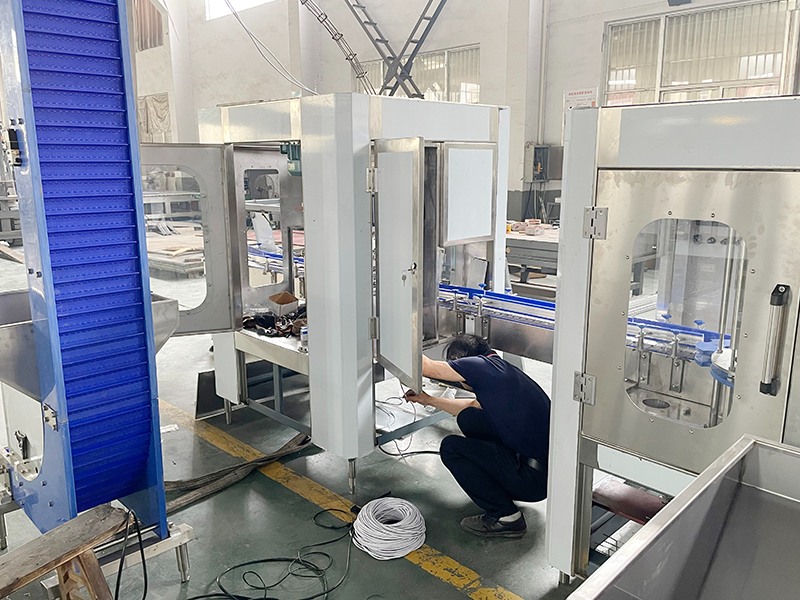
Example of an integrated MIC oil packaging line
Frequently Asked Questions
Which oil filling gun is best for high-viscosity oil?
A positive-displacement pump or piston system, a sufficiently large product path, and a positive shutoff outlet are common starting points. The final configuration depends on viscosity at filling temperature, container size, output target, and product testing.
When is a preset oil gun useful?
A preset gun suits repeated known quantities where automatic shutoff can reduce operator attention and routine overfill risk. Continuous packaged-goods production may be better served by a semi-automatic or automatic filler with integrated container handling.
What information should be sent with an RFQ?
Provide the oil specification and safety data sheet, viscosity at filling temperature, container and closure drawings, fill range, accepted output target, accuracy basis, utilities, site classification, and required upstream or downstream machines. These details allow the supplier to evaluate the complete filling circuit.
Final Thoughts
Choosing among the types of oil filling guns for industrial use starts with the oil, container, dosing basis, and production target. Send MIC these application details to discuss a suitable oil filling machine or connected packaging line.